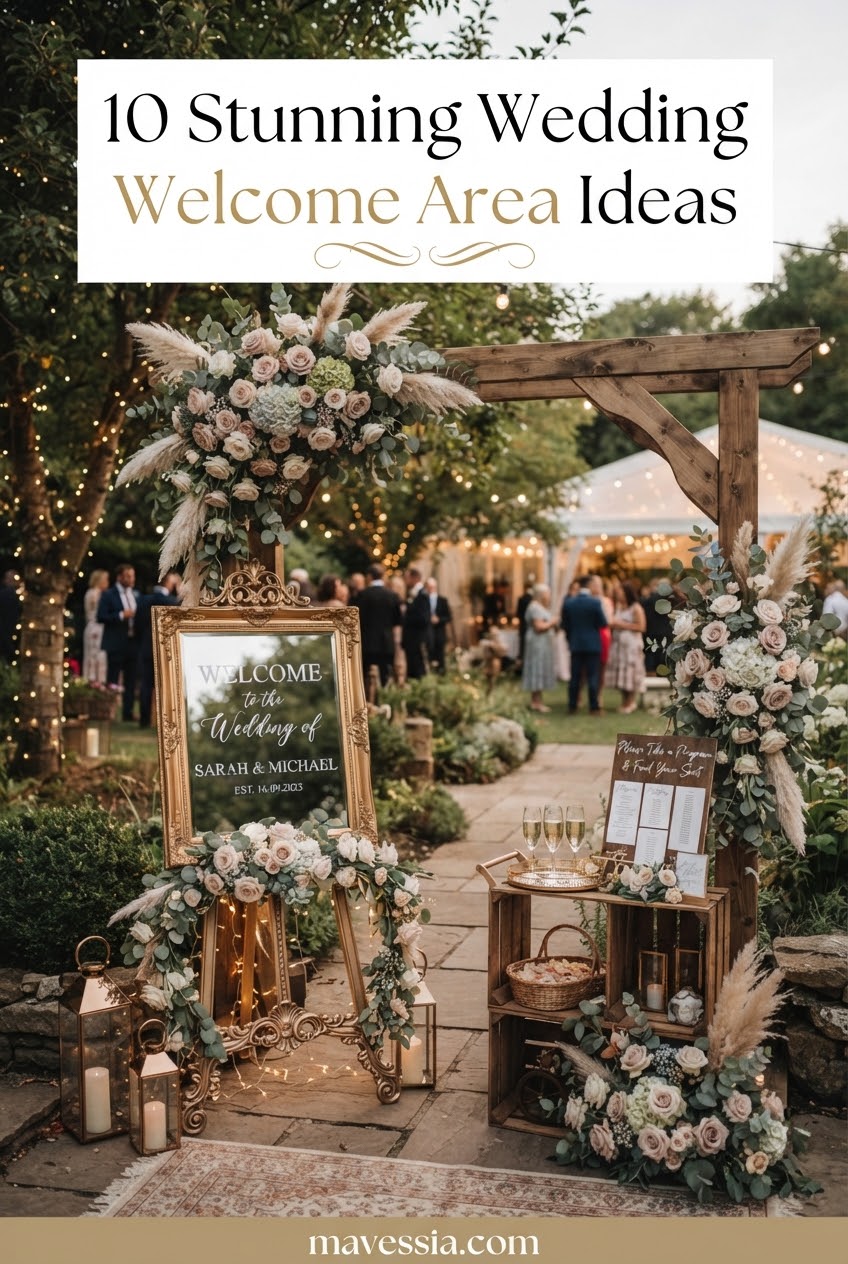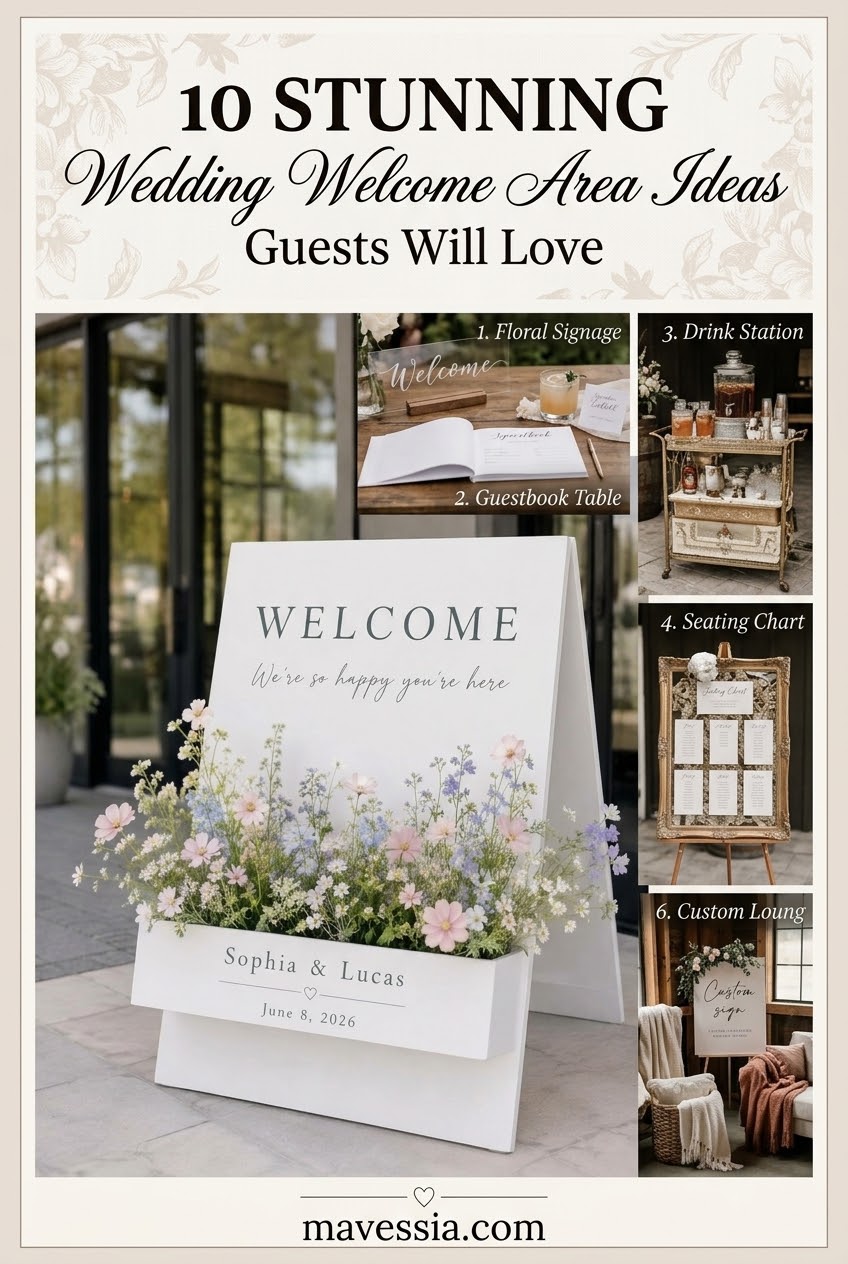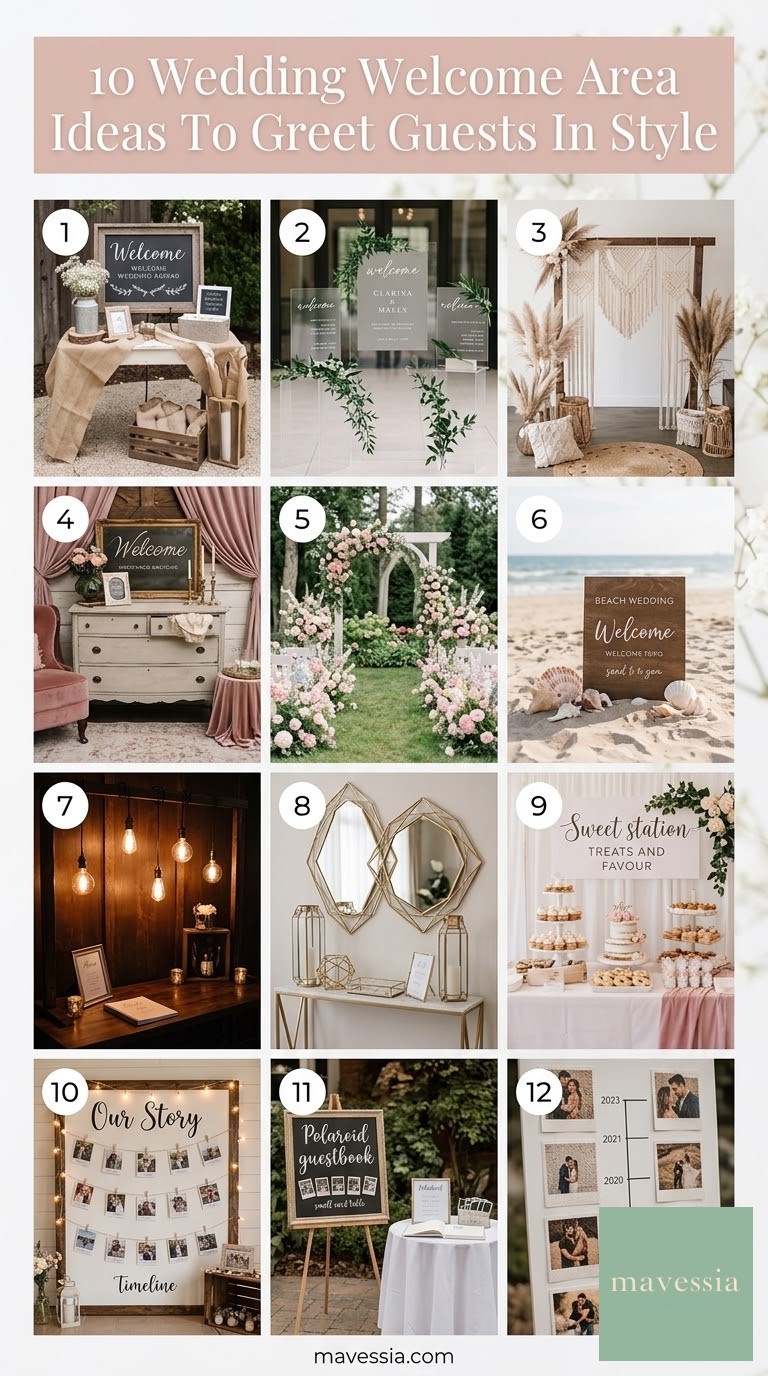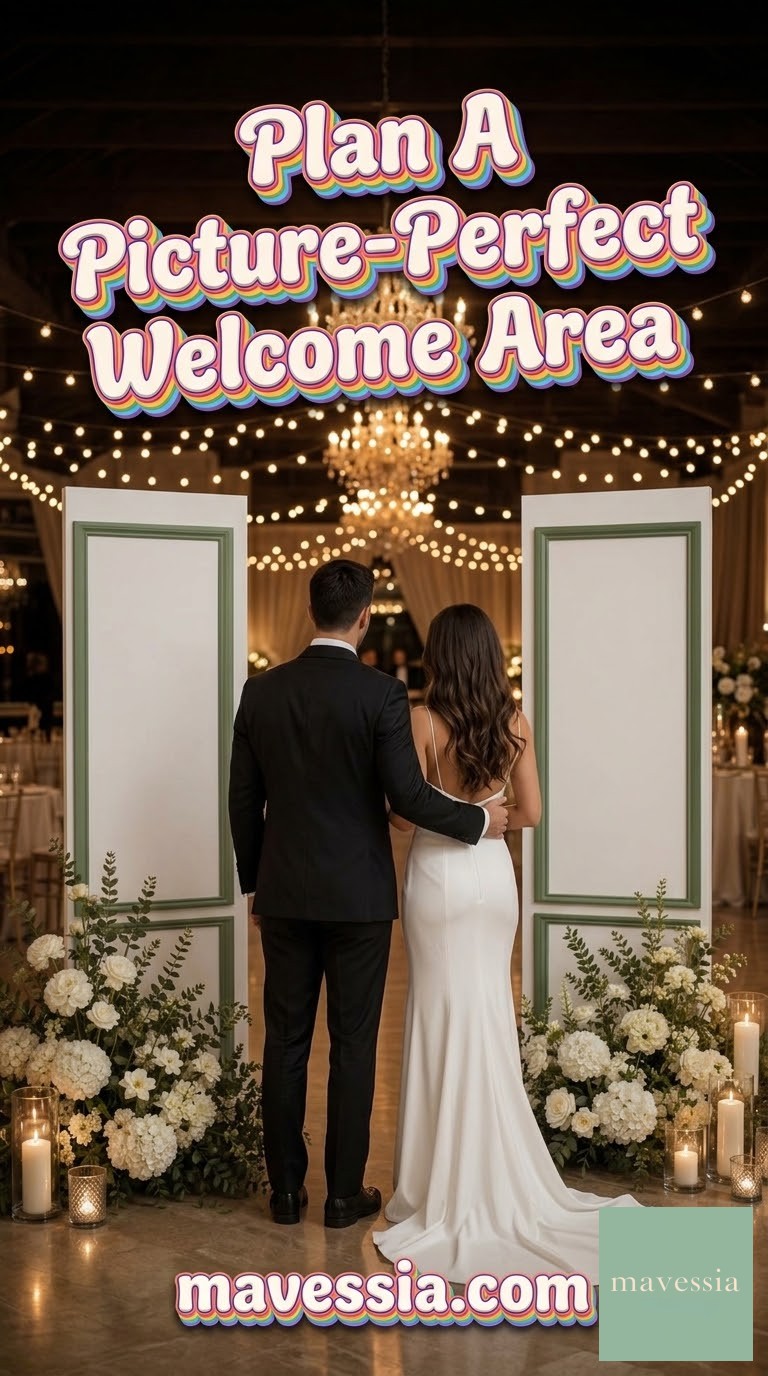
In eleven years of running weddings, I clocked exactly how long it takes a guest to decide whether they're at a thrown-together party or a well-loved one — about ninety seconds, usually spent standing at the welcome table. That vignette is doing more work than any other single element on your day: it sets tone, gives guests something to do while they wait for seating, and photographs beautifully for approximately no extra cost. Here are ten real approaches, from the sandwich-board-and-wildflowers you build yourself to the backlit marquee you absolutely hire out.
The Layered Garden Vignette
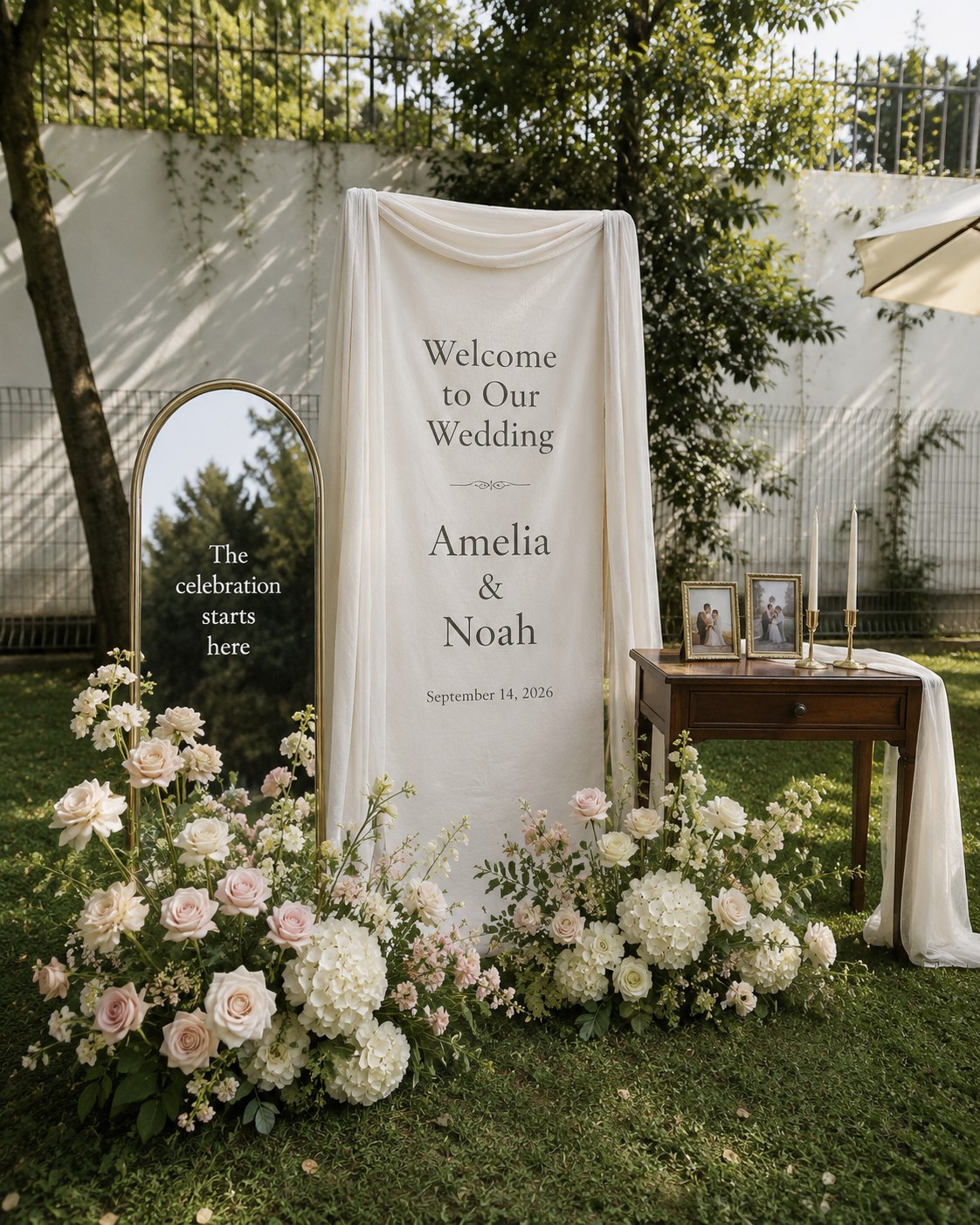
This is the welcome area with the most moving parts, and it earns every one of them: a draped fabric banner on a stand, an arched mirror leaned in beside it with a hand-written line, and a side table dressed with framed photos and candlesticks. What makes it work is depth — guests read the banner, catch the mirror's message, then linger at the table long enough to actually look at the couple's photos instead of just walking past.
- Weight the mirror — a leaning arched mirror on grass in any wind needs a sandbag or a stake behind it, learned the hard way at a coastal wedding where the wind won round one.
- Borrow the drape — most florists or rental companies have plain ivory fabric on hand; you don't need to buy yardage.
- Personalize the table — framed engagement photos here do more emotional work than a second florals cluster would.
This is a Weekend Project if you're sourcing your own stand and fabric, and it scales beautifully from an intimate garden ceremony up to a big-love guest list, since the three pieces can spread wide or tuck close depending on your entrance.
The Polaroid Memory Table
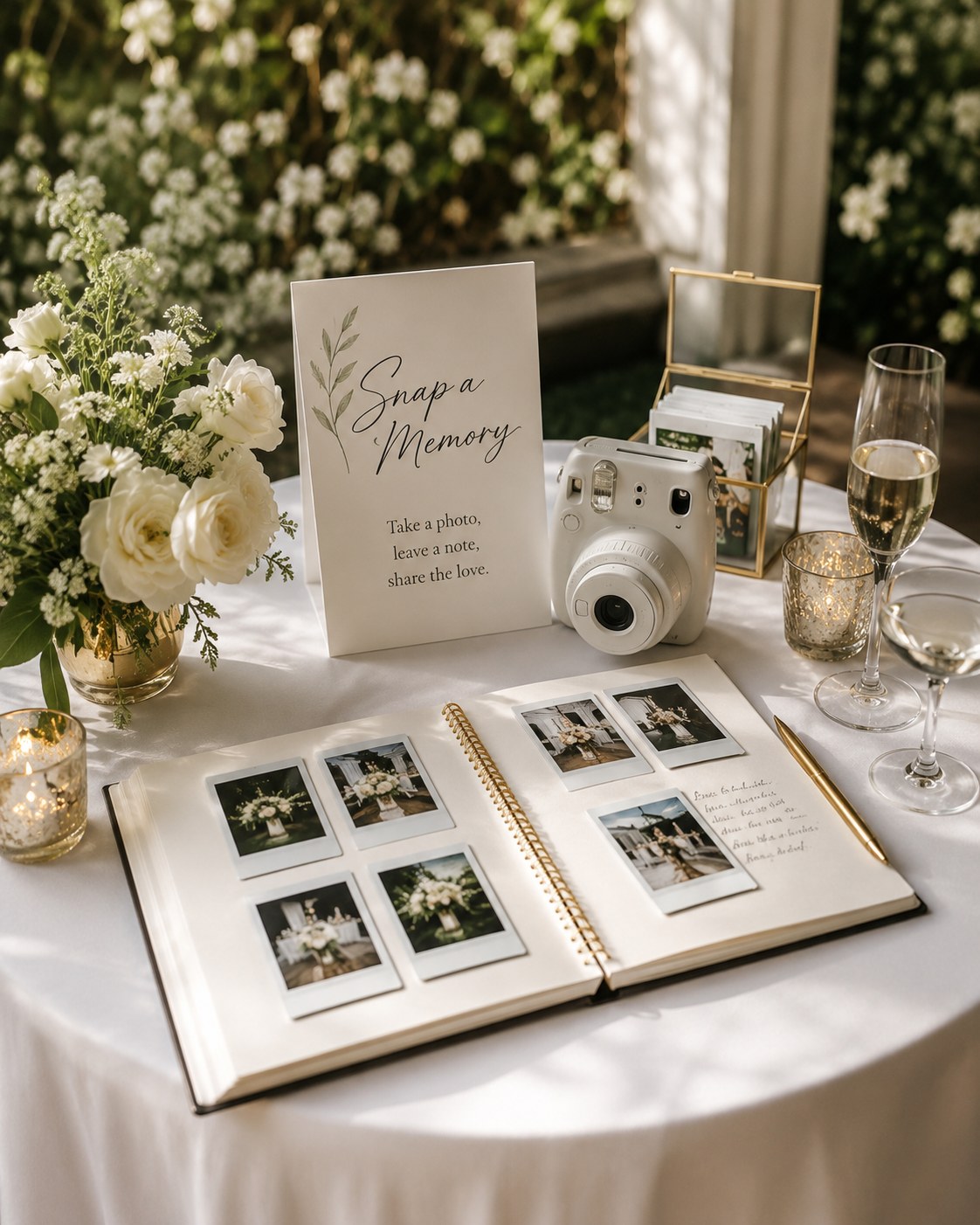
Swap the traditional guest book for an instant camera, a blank album, and a sign inviting people to snap a memory, and you get something better than signatures: a visual record shot from the guest's own eye level. I've watched grandmothers and college roommates alike light up at an instax camera in a way they never do at a pen.
The budget reality: film runs roughly $1 per photo, so a wedding of 100 guests taking two shots each is a real $200 line item — factor it in, don't let it surprise you at checkout.
Assign one bridesmaid or a willing cousin to restock film during dinner. Left unattended, the camera runs dry by the toast, and that's the hour you actually want it working.
Pre-number the album pages so photos land in some order, and leave a pen tethered nearby — untethered pens have a way of leaving with a guest's coat. This is Weeknight Doable in terms of setup; the only real planning is buying enough film cartridges in advance.
The Ballroom Double Sign
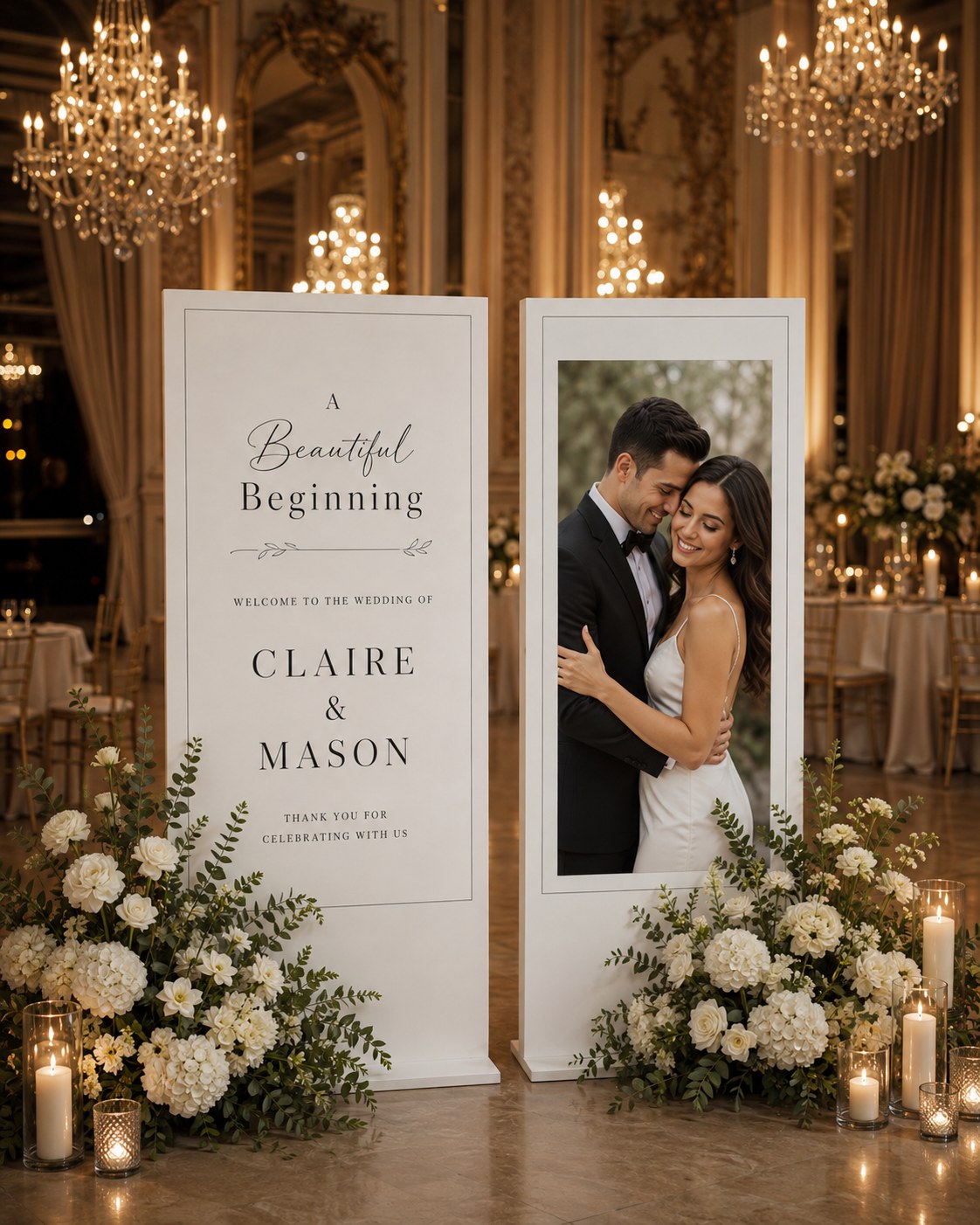
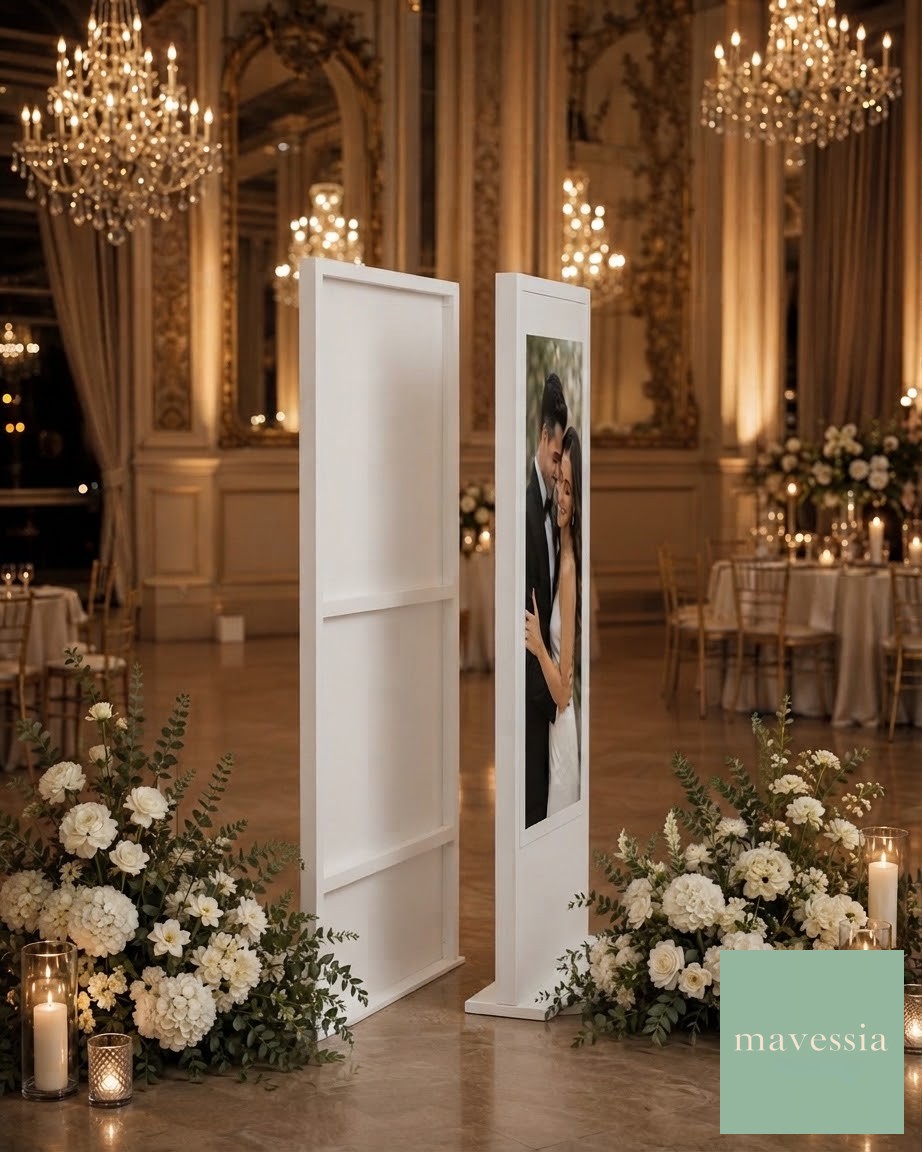
Under chandeliers, a single welcome sign reads small. This pairing — a text panel announcing a beautiful beginning alongside a full-scale engagement portrait, both grounded in candlelit floral clusters — gives the entrance the same visual weight as the room behind it. It's built for a big-love guest count and a formal venue where a tabletop sign would simply disappear.
Where the money actually goes
- Large-format photo printing on rigid board runs $150–$400 depending on size and finish — ask your planner or venue for a local print shop rather than a wedding-specific vendor, who'll mark it up.
- Two floral clusters instead of one roughly doubles that line item, so if the budget's tight, keep the photo panel and drop to a single sign.
From my day-of clipboard: get the sign and portrait placed and photographed before the candles burn down an inch — that's usually your best light, and it's gone within the hour.
The Wildflower Sandwich Board
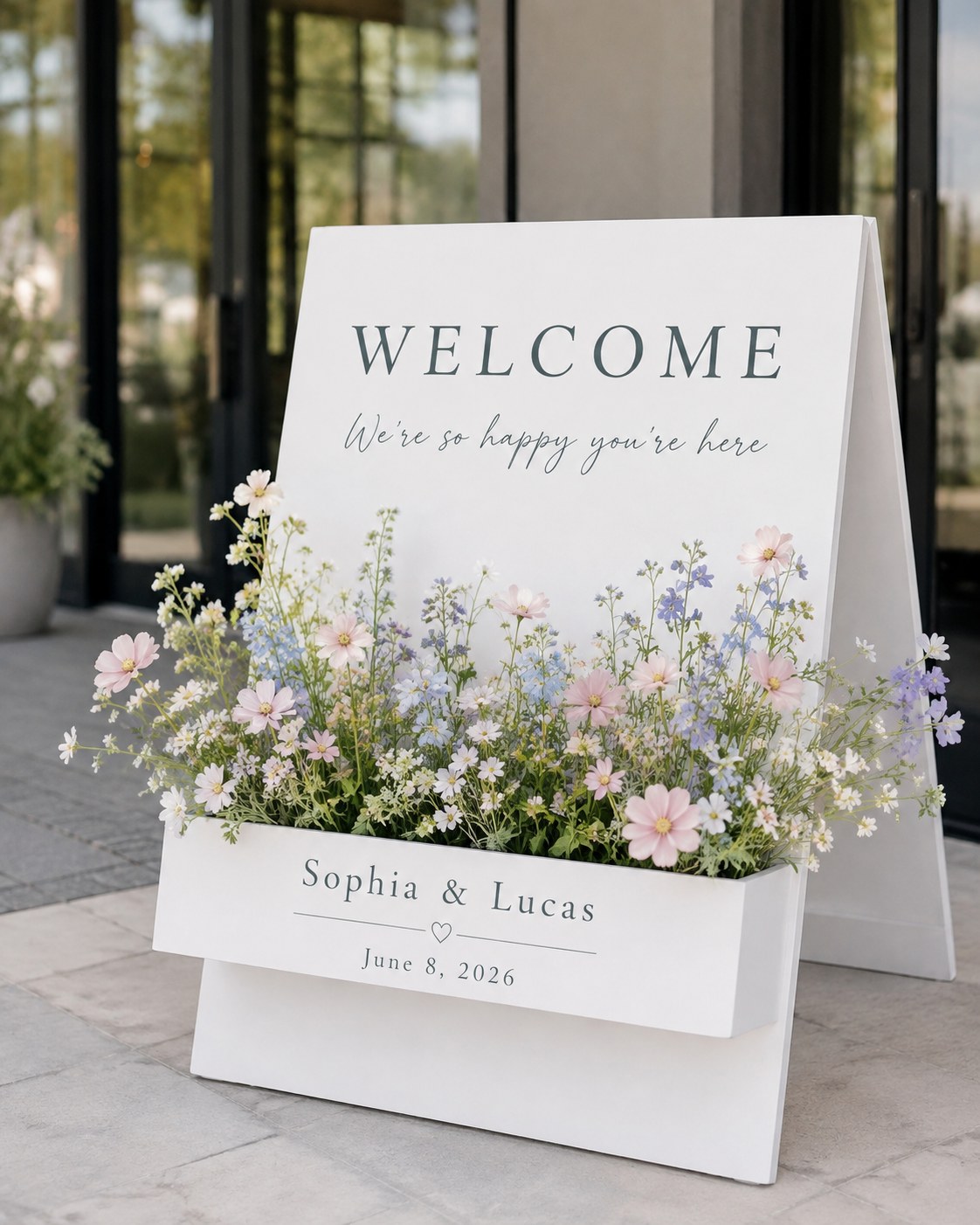
A white A-frame sign with a built-in flower box reading WELCOME, we're so happy you're here is the most flexible entrance piece I recommend to couples on realistic budgets. It's freestanding, needs no rental stand, and works against glass doors, brick, or grass equally well.
Ask your florist for a "grow-through" box — foam or a chicken-wire cage set inside the sign's built-in planter, filled with loose garden flowers like cosmos and stock rather than a tight formal arrangement. It reads relaxed on purpose and costs a fraction of a matching floral installation elsewhere on site.
This is a Weekend Project if you build the sign yourself from a printed vinyl panel and a hardware-store easel frame, or a straightforward rental if you'd rather not. Either way, it's the one welcome piece I tell intimate-wedding couples (6–8 guests, no big installation budget) to prioritize — it does more visual work per dollar than almost anything else on this list.
The Backlit Sunset Marquee
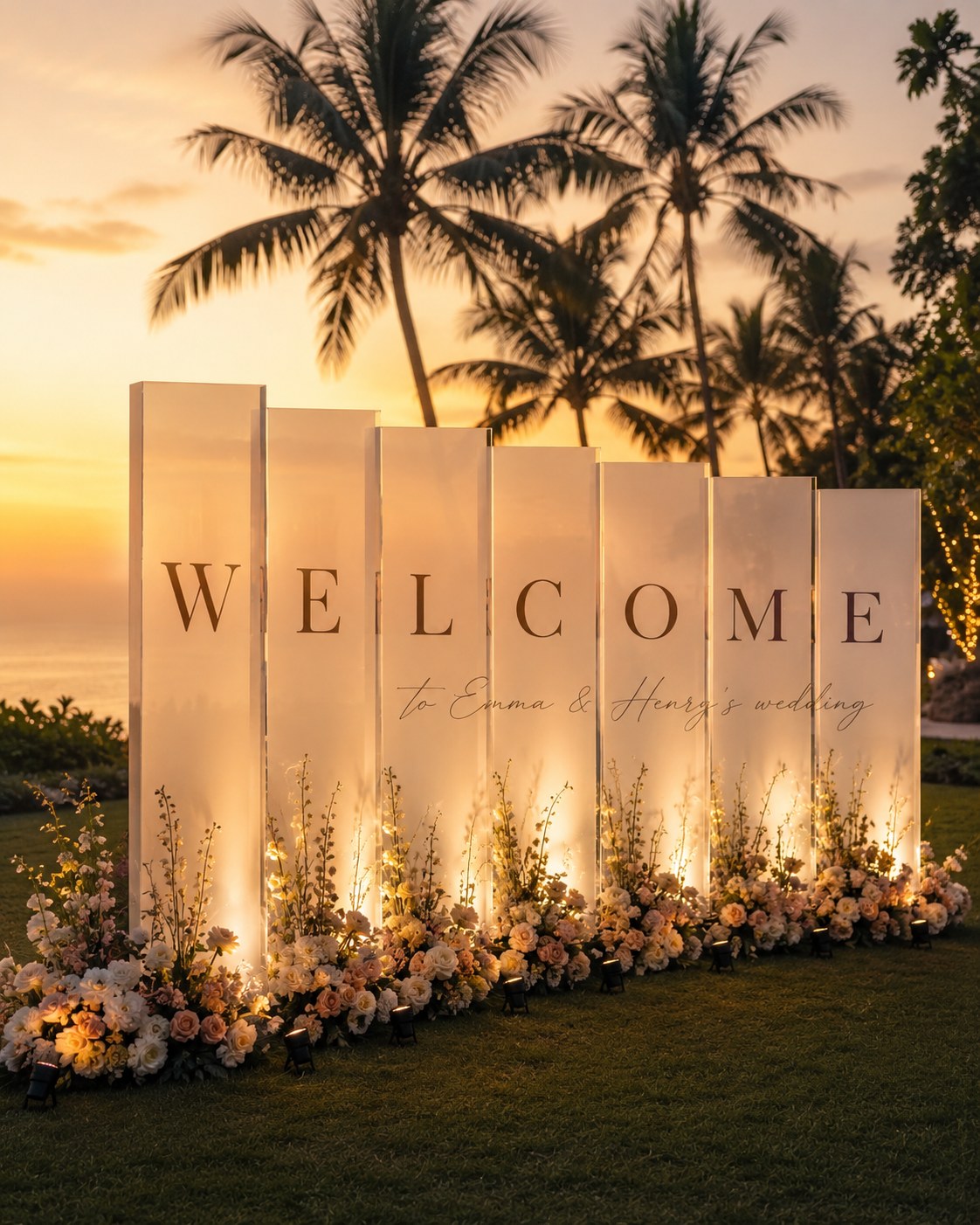
Freestanding illuminated letters spelling WELCOME, glowing gold against palm trees at golden hour — this is destination-wedding signage, and it's the one entry on this list I file firmly under Hire It Out. The panels need internal lighting, a power source or battery pack, and a rental company experienced with outdoor installs.
- Book this early — beach and resort venues often have exactly one vendor who does illuminated signage locally, and their calendar fills first.
- Confirm the power plan in writing — I've seen a gorgeous marquee sit dark all evening because nobody ran the extension cord before the caterer's generator was already maxed out.
- Schedule your arrival photos for the thirty minutes around sunset — this piece is built for that exact light and looks ordinary at noon.
This is a real splurge, typically several hundred to over a thousand dollars for rental and setup — worth it if a golden-hour photo of this sign is genuinely the image you want from your wedding, and worth skipping if it isn't.
The Meadow-Box Welcome Sign
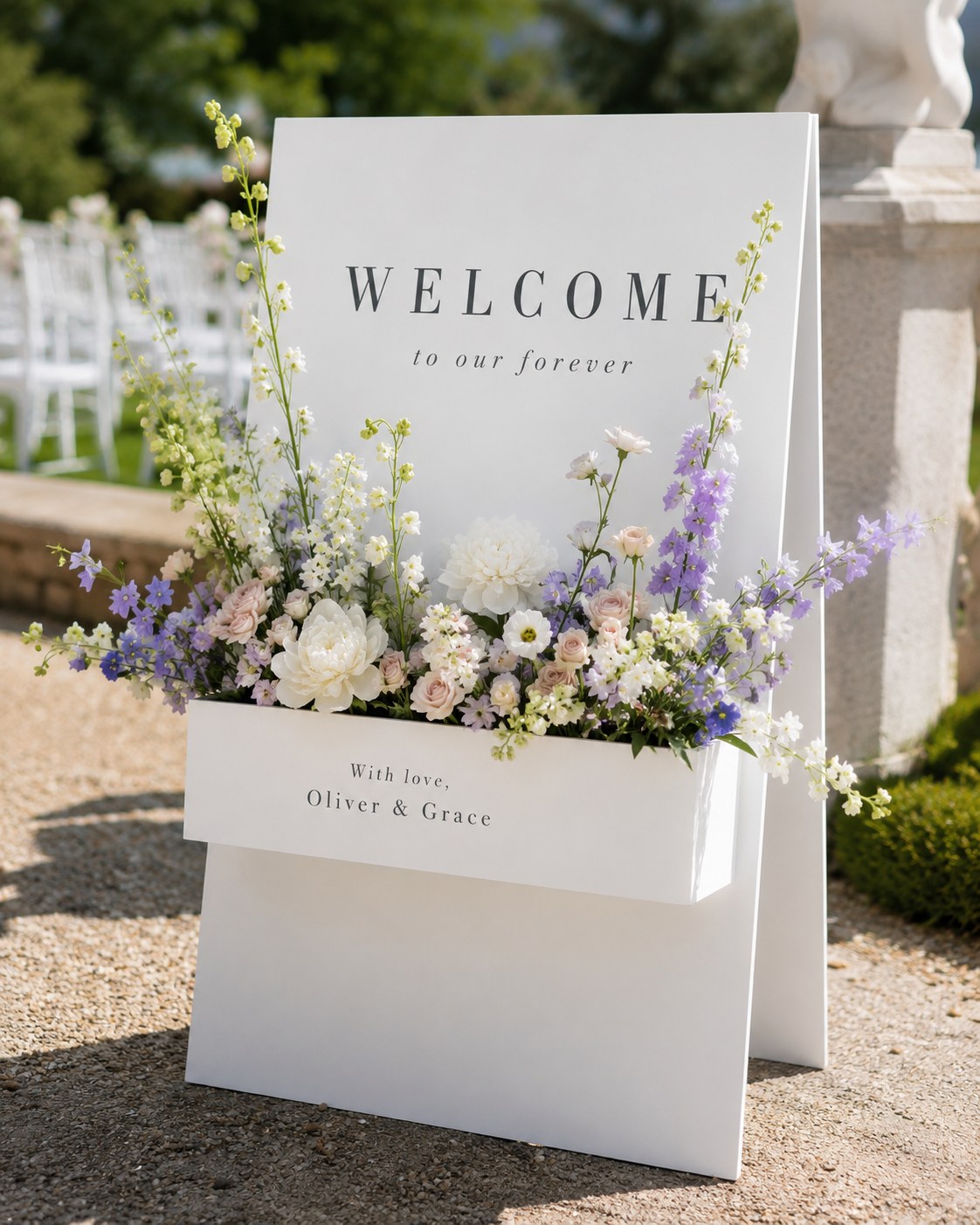
Close cousin to the sandwich board above, but placed differently and dressed differently: this one reads welcome to our forever, sits on gravel at the entrance to a ceremony aisle rather than the reception, and carries a wilder mix of delphinium, dahlia, and cosmos spilling well past the box's edges.
The distinction matters for placement. A reception welcome sign greets guests arriving from parking or valet; a ceremony marker like this one belongs right where guests turn to find their seats, often paired with the aisle runner or ceremony chairs just behind it.
If you're working with an estate or garden venue that already has mature landscaping, let the flower box echo what's growing nearby rather than fighting it — a florist worth hiring will walk the site with you for exactly this reason. Family-size weddings (12–16 to around 25 guests) get the most visual return here, since the sign has to hold its own against real garden backdrop rather than a blank wall.
The Mirror-and-Bloom Statement Wall
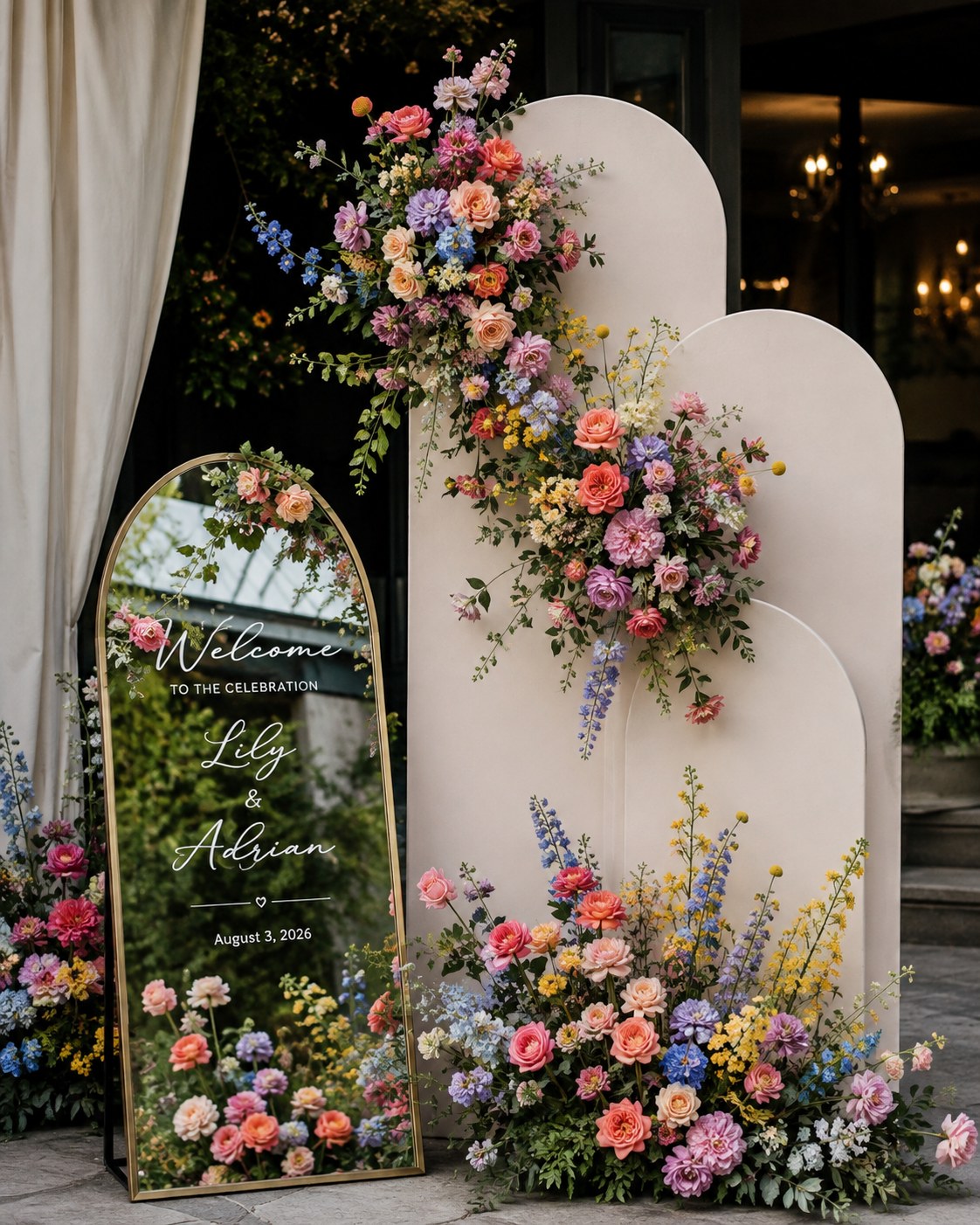
This is the entrance built for couples who want the welcome area to double as a photo backdrop: an arched mirror sign beside a trio of tall arch forms, each dripping with a saturated, maximalist mix of ranunculus, delphinium, and garden roses in nearly every color at once.
How to scale it
- Full version — three arch forms plus mirror, realistically a $2,000–$4,000 floral line item depending on market and season.
- Scaled version — one arch form and the mirror alone; ask your florist to concentrate the same flower budget into a denser cluster on fewer structures rather than thinning it across all three.
- Off-season swap — dahlias and garden roses run cheapest in late summer into early fall; a spring wedding chasing this exact palette will pay a premium for imported stems.
This piece needs real floor space and reads best photographed straight-on, so walk the entrance with your photographer beforehand and mark where the shot actually works.
The Rehearsal Dinner Framed Sign
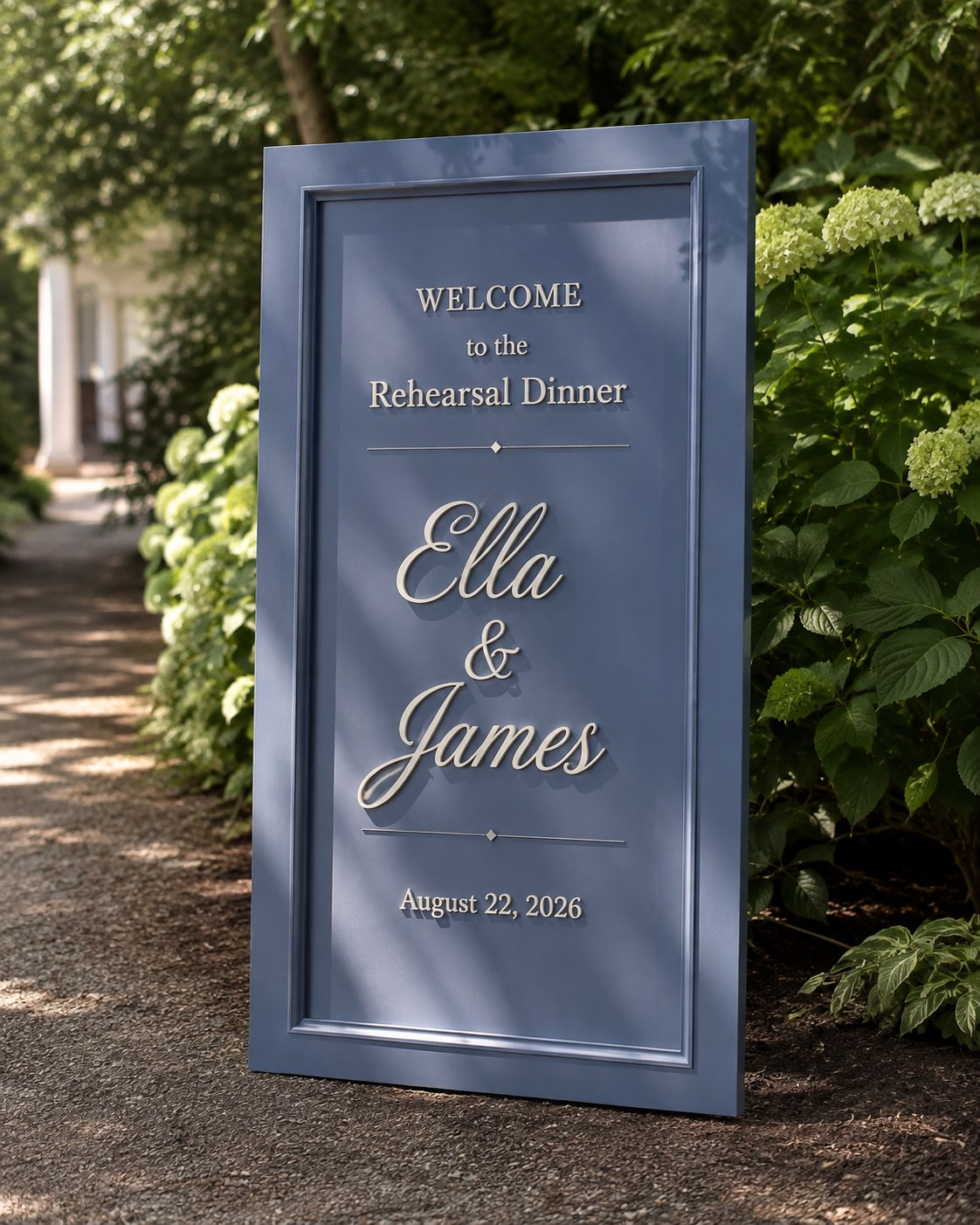
Worth separating from wedding-day signage entirely: a simple framed panel, no florals attached, placed along a garden path to mark the rehearsal dinner specifically. Deep navy with engraved-style lettering photographs like it cost more than it did, precisely because the color does the heavy lifting instead of an installation.
Why I like a standalone sign here: the rehearsal dinner is usually a smaller, more intimate guest list, and a florals-heavy welcome area can accidentally out-dress the actual wedding day the following afternoon. Keep the visual hierarchy in order — save your biggest floral moment for the day itself.
This is a rental or a one-time acrylic print, either way a modest cost, and it's genuinely reusable — I've seen couples repaint or reprint the same frame for an anniversary dinner years later. Weeknight Doable if you're renting; a mild Weekend Project if you're having it printed and framed yourself.
The Classic Guestbook Table
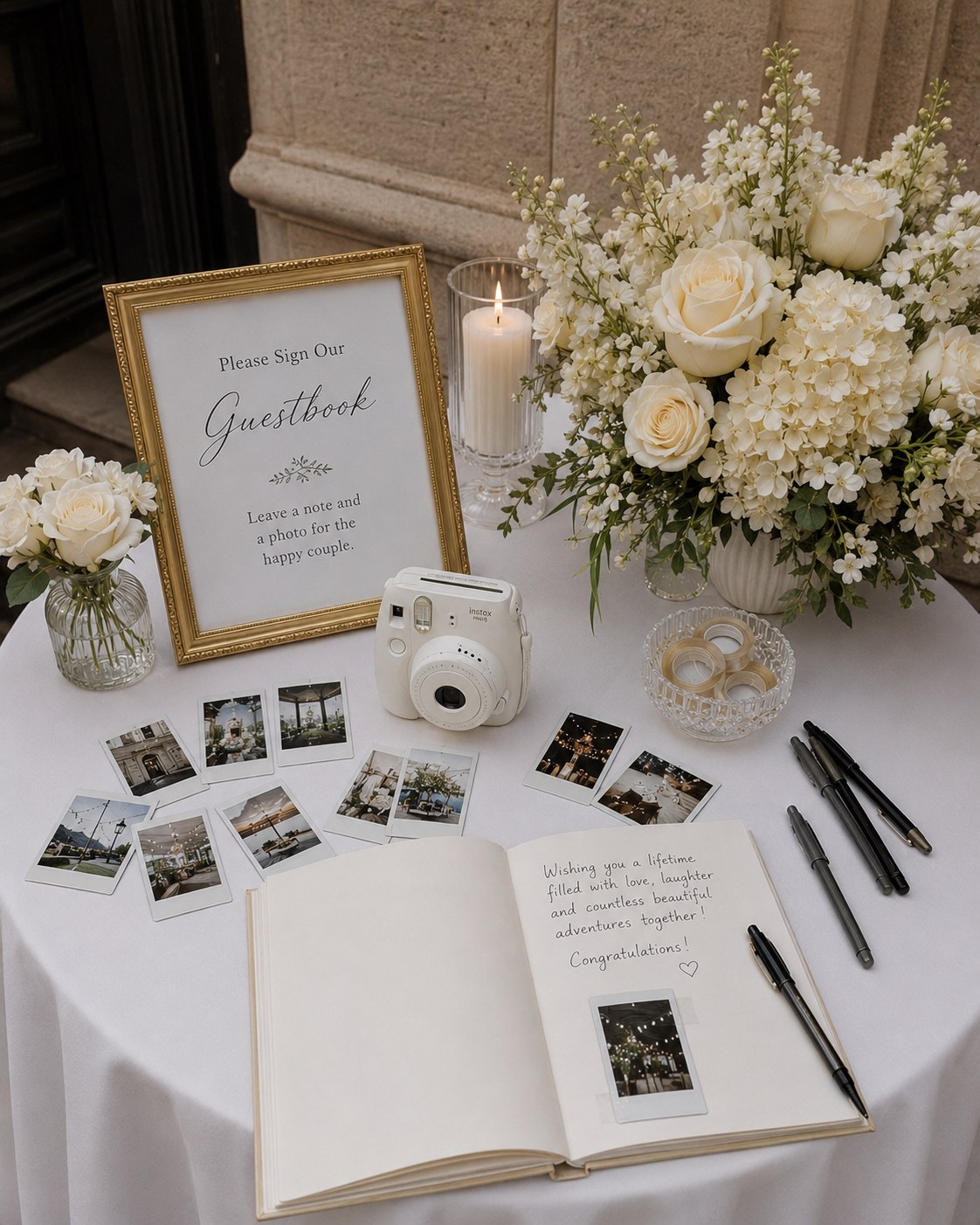
Round table, ivory linen, a gold-framed sign asking guests to sign and leave a photo, an instax camera stationed beside a proper guest book, ivory roses and hydrangea in a low arrangement, and a single taper burning nearby. This is the traditional welcome-table format, and I still book it more than any trend that's come along in the last decade — because it works.
- Pre-write the first page yourself or with a parent the week before — a blank first page makes guests hesitant to be the one who breaks it in.
- Keep three pens on the table, minimum — I've coordinated enough weddings to know one pen means a line forms and photos of the table start looking like a bank counter.
- Set the candle in a hurricane glass, not open flame, if the table sits anywhere near a linen edge that might catch a breeze.
This whole setup runs comfortably under $150 if you're supplying your own book, camera, and florals from an existing arrangement — one of the better dollar-for-dollar pieces on this entire list.
The Rustic Crate Monogram
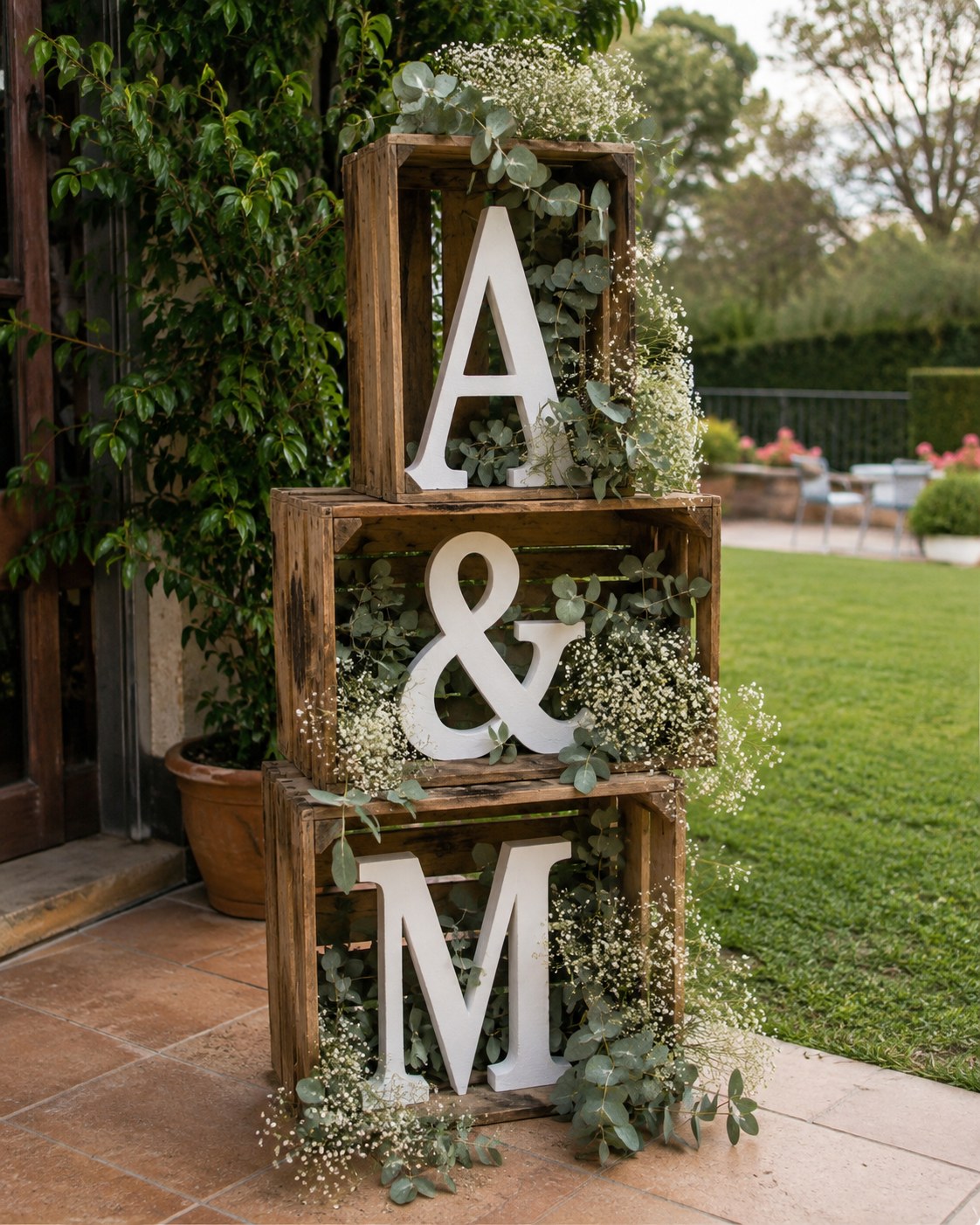
Three stacked wooden crates, oversized wooden letters spelling out the couple's initials with an ampersand between them, baby's breath and eucalyptus tucked into every gap — this is the entry-level DIY welcome piece, and I mean that as a compliment. It's the one I point budget-conscious couples toward first.
The real cost breakdown: secondhand or borrowed crates (often free — ask around, someone's father-in-law has three in a garage), wooden letters from a craft store ($15–$40 depending on size), and a bunch of baby's breath and eucalyptus greenery from your florist or a grocery store floral counter, typically under $40 total.
Because nothing here needs refrigeration, water tubes, or same-day delivery, you can build this the day before — genuinely make-ahead, which is rare for anything with fresh greenery in it. The crates go home with you afterward for storage, bookshelves, or next year's holiday décor. This is Weekend Project territory and one of the few pieces on this list an intimate 6–8 guest wedding can execute without hiring a single vendor.
Whichever version you land on, build it the day before if you possibly can — a welcome area is one of the few pieces of a wedding day that genuinely doesn't need you standing over it at 4pm, and that's a gift worth taking.

Frequently Asked Questions
How much should I realistically budget for a wedding welcome area?
It spans a huge range on purpose. A DIY sandwich board or crate monogram can land under $100 total. A florist-built sign with fresh arrangements runs $200–$600. A full statement installation with mirror signage and multiple arch forms can reach $2,000-plus. Pick based on what you actually want photographed, not what shows up first in a vendor's portfolio.
Do I need both a welcome sign and a separate guest book table?
Not always, and combining them is smart on a tighter budget or smaller footprint — a single table can hold a welcome message, a guest book or photo album, and a small arrangement together, as long as you give it enough surface space that it doesn't look crowded.
Should the rehearsal dinner get its own welcome sign, or can I skip it?
You can absolutely skip it — it's a nice-to-have, not a must. If you do include one, I'd keep it simple and separate from your wedding day's design so the rehearsal dinner doesn't visually compete with the day you're actually building toward.